Tether's Signal: A Contrarian Read on Bitcoin's $60K Prospects
Bitcoin's dip below $65,000 triggered $500 million in liquidations, yet a $3.1 billion contraction in Tether's market cap suggests selling exhaustion, historically preceding BTC rebounds.
Bitcoin's struggle to hold above $65,000 has intensified, with the asset currently trading around $64,500. This recent downturn has triggered substantial liquidations, pushing the total to $500 million as BTC dipped below the key support level. The broader sentiment reflects a market in flux, absorbing repeated rounds of selling pressure as the TradFi trading week begins.

While some analysts warn of a potential retest of $62,250 lows or even a sweep of the $60,000 mark, a deeper look at stablecoin dynamics suggests a more nuanced outlook. The overall crypto market has seen significant outflows, with funds shedding $4 billion over a five-week negative streak. This widespread capital withdrawal points to a structural tightening of crypto-native liquidity, a condition that has historically preceded market turning points.
Tether's Counter-Intuitive Indicator
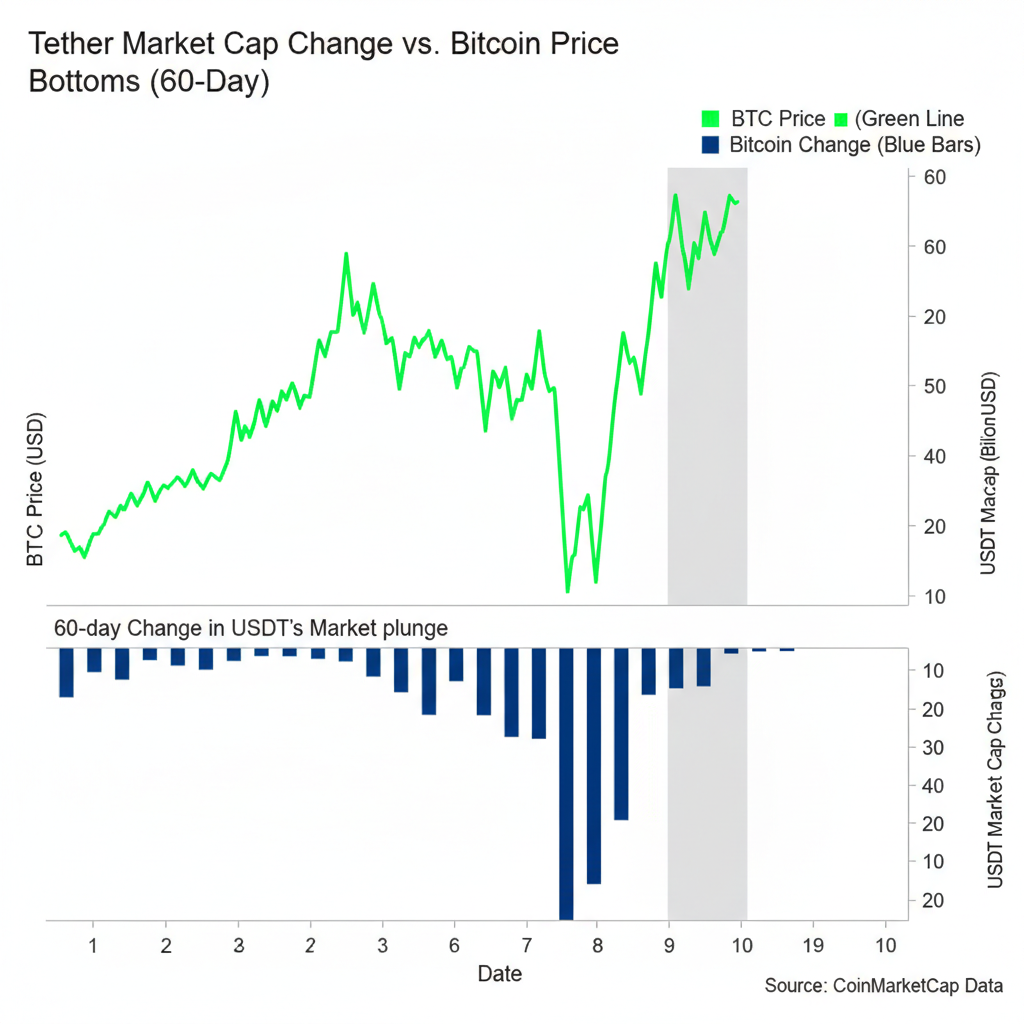
Amidst the current bearish undertones, data from Tether (USDT) market capitalization presents a compelling, albeit contrarian, signal. The 60-day change in USDT's market cap has declined by $3.1 billion, a level last seen just before Bitcoin carved its cycle bottom near $15,500 in late 2022. This historical precedent suggests that significant contractions in USDT market cap, often indicating liquidity withdrawal or forced redemptions, tend to occur at or near the exhaustion of selling pressure, rather than at the onset of prolonged downtrends.
The $3.1 billion contraction in Tether's 60-day market cap change mirrors conditions that preceded Bitcoin's 100% rally from its 2022 bear market lows.
Furthermore, Tether's market cap shed $1 billion in a single day recently—an event that has only occurred twice before, each time coinciding with local or macro bottoms for Bitcoin. These sharp drops in USDT typically reflect institutional or large-holder exits, which often mark a capitulation phase. For those monitoring market bottoms, this Tether signal provides a potentially powerful leading indicator, hinting that the current liquidity stress might be setting the stage for a rebound.
Whale Behavior and Altcoin Liquidation Risks
While Tether's data offers a potential silver lining, whale activity in Bitcoin and liquidation risks in altcoins demand attention. Since February 13, large holders have moved approximately 900,000 BTC, equivalent to $60 billion. This significant transfer activity suggests some whales may be preparing to exit positions, particularly after limited price appreciation. If this selling pressure continues, it could indeed push Bitcoin towards the $60,000 support level, validating some of the more bearish short-term outlooks.
Concurrently, several altcoins, including Ethereum (ETH), BNB, and BCH, are exhibiting heavy short imbalance pressure. Ethereum's seven-day liquidation map shows a dominance of potential short liquidations. An unexpected rebound to $2,000 could trigger $2 billion in short liquidations for ETH, with a move to $2,160 potentially liquidating $3.6 billion. This imbalance creates a volatile environment where a sudden short squeeze could lead to sharp price reversals, despite prevailing bearish sentiment driven by factors like Vitalik Buterin reducing ETH holdings and increased inflows to exchanges.
Investors should monitor the $65,000 level for Bitcoin closely. A sustained recovery above this point, coupled with a confirmation of selling exhaustion indicated by Tether's market cap stability, would be a strong signal for a potential reversal. Conversely, a clear breakdown below $64,142 could open the path to $60,000, where significant support would be tested.