Solana and Ethereum Defy L1 Commoditization Narrative Amidst Shifting Market Dynamics
Institutional capital is concentrating on Ethereum and Solana, challenging the idea that Layer 1 blockspace is a commodity and highlighting their foundational role for future financial infrastructure.
The prevailing notion that Layer 1 (L1) blockchain blockspace has become a commoditized asset is being challenged by institutional investment patterns, particularly concerning Ethereum and Solana. Despite newer L1s aggressively competing on fees and throughput, a significant concentration of institutional capital and development continues to favor these established networks. This trend suggests a more nuanced reality than the 'L1 as a commodity' argument implies.
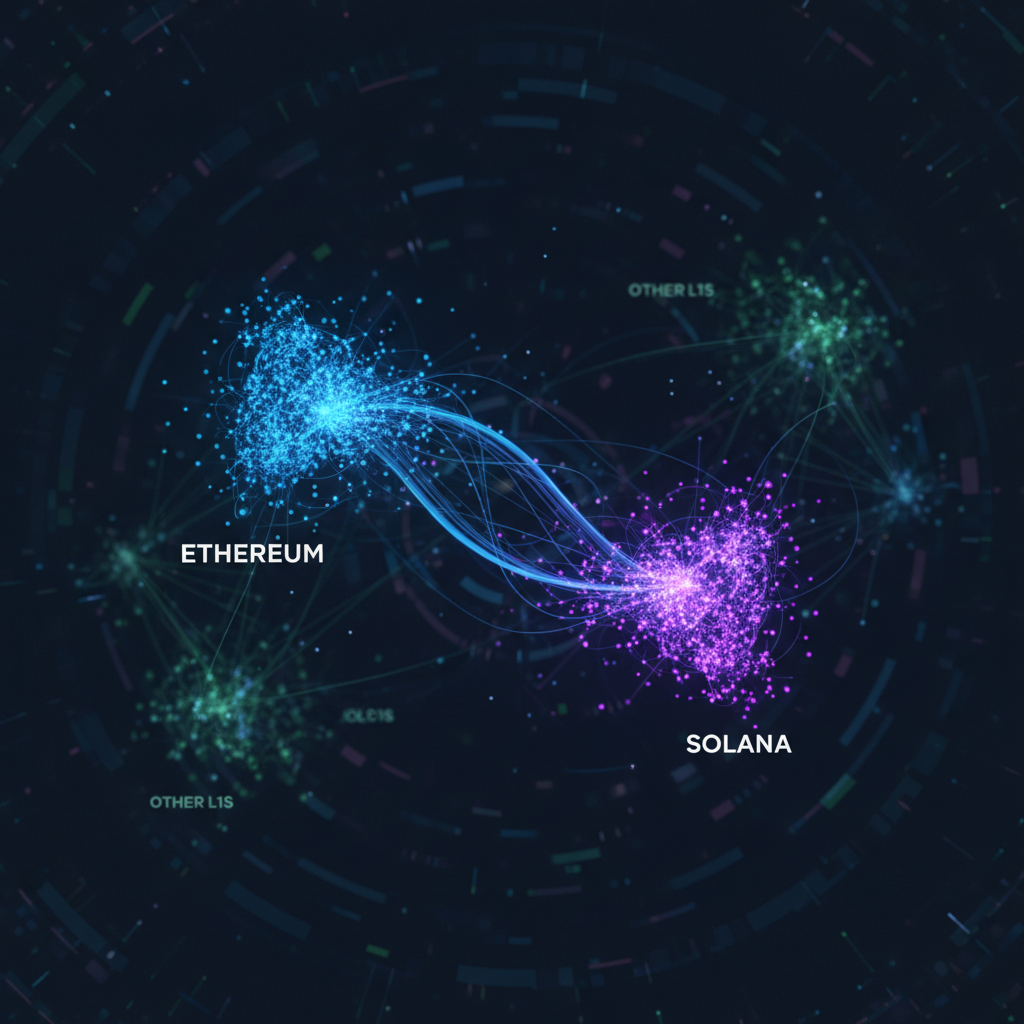
Bitwise CIO Matt Hougan points out that if L1 infrastructure were truly commoditized, capital and development would be evenly distributed. Instead, institutional builders are showing virtually no interest in the twentieth largest L1, opting for the well-trodden paths of Ethereum and Solana. This preference is not merely about current transaction costs, which are low due to an oversupply of bandwidth, but rather a strategic positioning for future demand. The critical question remains: what happens when stablecoins, tokenization, and DeFi scale into the trillions of dollars?
Institutional Focus and Market Bifurcation
The continued dominance of Ethereum and Solana in terms of mindshare, liquidity, and developer activity highlights a bifurcation in the L1 market. Institutional players are not simply chasing the lowest fees; they are investing in ecosystems with proven stability, robust developer communities, and deep liquidity. This behavior suggests that factors beyond raw blockspace cost — such as network effects, security, and future scalability potential — are paramount for large-scale adoption.
"The real question is what happens when demand scales as stablecoins/tokenization/DeFi grow into the trillions."
While Bitcoin has shown signs of potential recovery, with CME 'smart money' slashing short bets and targeting an $85,000 rebound, and certain altcoins like Bitcoin Cash (BCH), Morpho, and Decred (DCR) defying the broader bear market, the L1 narrative remains distinct. The overall market sentiment is mixed; Bitcoin recently dipped to $67,000 amidst renewed trade tensions, and Trump-themed meme coins have seen retail investors lose $4.3 billion, illustrating the speculative risks prevalent in other segments of the crypto economy.

Future Implications for Solana Ecosystem
For the Solana ecosystem, this institutional preference is a strong validation. It positions Solana not merely as a high-throughput alternative, but as a critical piece of the future financial infrastructure alongside Ethereum. As the market matures, the focus will likely shift from sheer technical specifications to the comprehensive value proposition of an L1, encompassing its ecosystem, developer support, and perceived long-term viability. The current low-fee environment on top-tier L1s, which Hougan attributes to an excess of bandwidth, is a temporary state. When demand truly scales, the networks that have attracted significant institutional building will be best positioned to capitalize.
This continued institutional focus on a select few L1s suggests that for long-term participants, the perceived value of secure, established networks outweighs the allure of nascent, cheaper alternatives. The market is signaling a flight to quality for foundational infrastructure. For investors, this implies a need to distinguish between speculative plays and infrastructure plays, where the latter's value is increasingly tied to institutional adoption and future utility, rather than just current blockspace cost. The Solana ecosystem stands to benefit significantly from this evolving perspective, securing its place as a key player in the next wave of digital asset growth.