HyperLiquid Thrives in Volatility as Solana Faces Liquidation Threats
HyperLiquid's HYPE token surged 23.9% year-to-date, demonstrating the decentralized exchange's ability to monetize market volatility, while Solana faces significant liquidation risks amid a period of price compression.
While the broader crypto market shows signs of a tentative recovery, marked by Bitcoin nearing $70,000 and a significant rebound in crypto fund inflows, a deeper look reveals divergent narratives. Decentralized derivatives exchanges, particularly HyperLiquid (HYPE), are demonstrating resilience by monetizing market volatility, a stark contrast to the liquidation risks emerging for assets like Solana (SOL).

HyperLiquid’s native token, HYPE, has seen a 23.9% year-to-date increase, a notable decoupling from Bitcoin's 23.7% decline and Ether's 33%+ drop over the same period. This performance underscores HyperLiquid’s business model, which thrives on trading activity rather than sustained price appreciation. In a market characterized by drawdowns and macro shocks, derivatives volume tends to persist as traders shift from spot buying to strategic positioning. HyperLiquid's monthly trading volume exceeded $200 billion in both January and February, while competitors like Aster and Lighter saw significant declines. The platform’s total volume since inception has now reached $4 trillion, indicating robust activity even in challenging conditions.
Volatility as a Business Model
HyperLiquid's success is rooted in its perpetual futures offering, which allows traders to leverage long or short positions. This structure is particularly effective in turbulent markets, as the exchange collects fees on both sides of a trade. Rather than relying on a continuous upward trend, HyperLiquid's model captures turnover, making it less susceptible to the directional biases that impact spot-focused platforms. The platform's ability to generate revenue from volatility positions it uniquely in a market segment often perceived as high-risk. This also highlights a broader trend: as the crypto market matures, infrastructure that facilitates sophisticated trading strategies gains prominence, irrespective of prevailing market sentiment.
Solana's Volatility Compression and Liquidation Risks
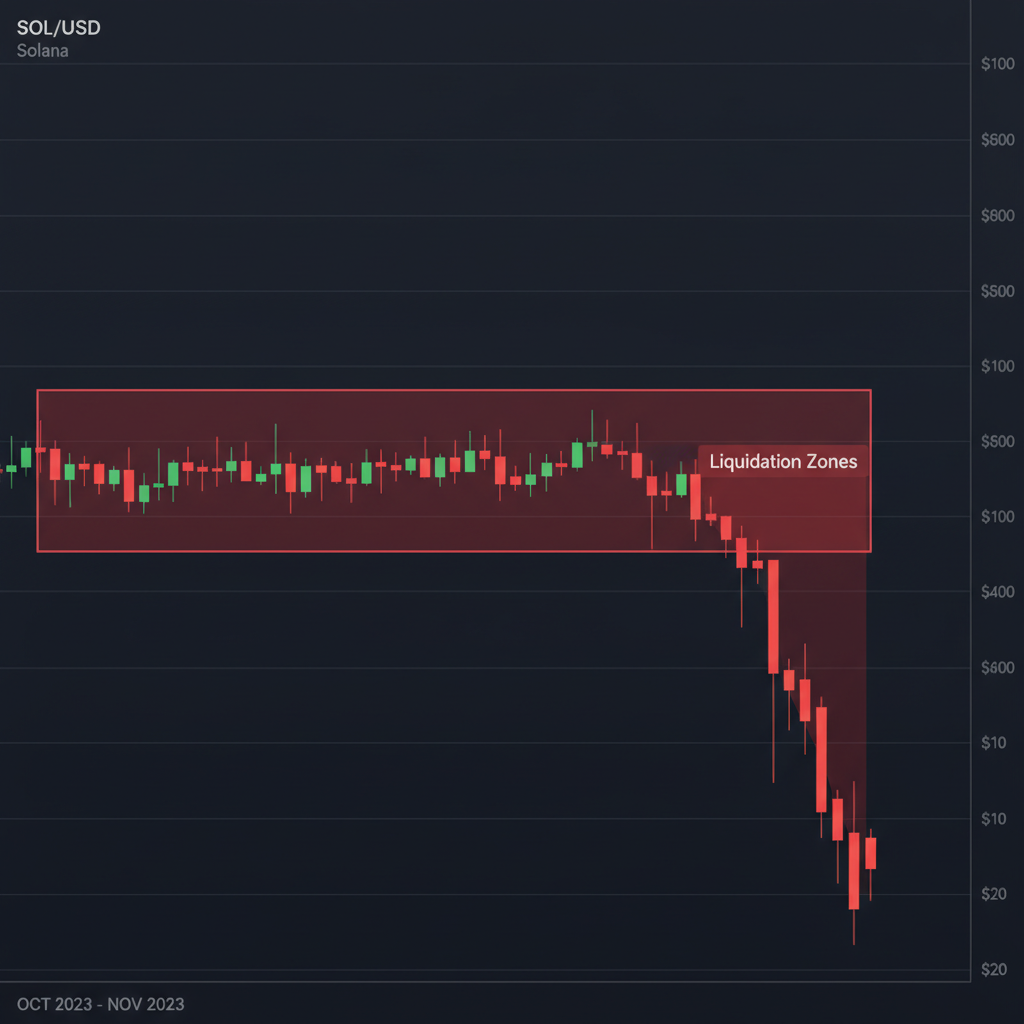
In contrast to HyperLiquid's robust performance, Solana (SOL) is entering a period of heightened uncertainty. SOL has traded sideways around $84 since early February, a phase described as “volatility compression.” Historically, such periods often precede explosive price movements, which can lead to significant liquidations for leveraged traders. The Solana Buy/Sell Pressure Delta indicator, which has recently turned red and declined sharply, reinforces this potential for a major move. Analyst Joao Wedson notes that this signal could indicate either a local bottom followed by a strong upside reversal or the beginning of a strong bear market, similar to 2022.
The 7-day liquidation map from Coinglass shows that a drop to $74 for SOL this week could trigger cumulative long position liquidations of up to $376 million.
This indicates that despite recent inflows into Solana ETPs—$54 million last week, contributing to $156 million year-to-date—the underlying spot market remains precarious. Traders are advised to monitor SOL's price action closely, especially around the $74 support level, as a breakdown could initiate a cascade of liquidations for those positioned with leverage. The current environment demands a nuanced approach, differentiating between platforms built to monetize market activity and assets exposed to directional volatility.