Bitcoin's Geopolitical Resilience Tested, Solana's Support Weakens Amid Market Shifts
Bitcoin shows resilience towards $70,000 due to ETF inflows despite geopolitical tensions, while Solana faces significant selling pressure and potential downside towards $77, as traditional finance increasingly adopts 24/7 crypto rails.
Bitcoin has repeatedly tested and failed to hold the $70,000 level, now trading around $67,600. This volatility comes amidst ongoing geopolitical tensions in the Middle East, which are impacting broader risk assets and Asian equities. Despite the macro pressures, Bitcoin (BTC) has shown a modest weekly gain of 3.4%, largely attributed to a post-strike recovery and sustained institutional interest through ETF inflows. The market's resilience, however, is not uniform across the crypto landscape. While BTC and some majors like BNB and XRP exhibit relative stability, others, particularly Solana (SOL) and Ethereum (ETH), are experiencing downward pressure.

Solana Faces Significant Downside Risk
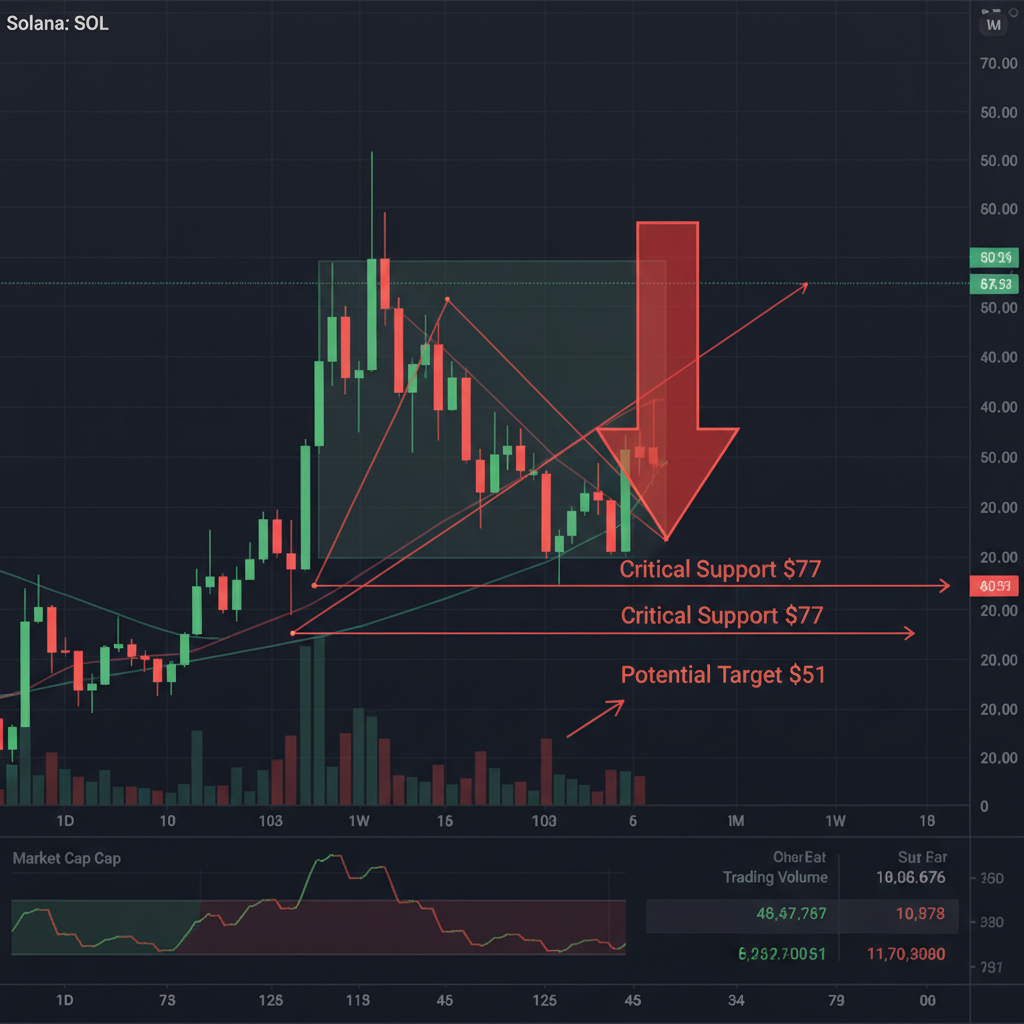
Solana (SOL) is under considerable scrutiny, currently trading at $85.16 and marking itself as the worst-performing major on a weekly basis, down 4.2%. Analysis of short-term holder (STH) Net Unrealized Profit/Loss (NUPL) indicates rising unrealized profits among STHs, a demographic typically quick to sell. This trend suggests increased selling pressure on SOL, especially in the absence of a similar profit rise among long-term holders (LTHs) who might otherwise provide market stabilization. If this selling pressure intensifies, Solana could face a significant price drop.
A bearish flag pattern has emerged for Solana, suggesting a potential drop to $51 if the critical support level of $77 fails to hold.
This technical indicator, coupled with the observed investor behavior, paints a cautious picture for Solana in the near term. Exchange net position changes further corroborate this, indicating a build-up of sell pressure on the asset. The market is waiting for clearer signals, particularly regarding the geopolitical situation, before establishing a more definitive trend.
Traditional Finance Eyes Crypto Rails
Beyond the immediate price action, a significant long-term shift is underway as traditional finance (TradFi) accelerates its adoption of crypto rails. The recent Middle East conflict highlighted the inherent advantages of 24/7 crypto trading platforms. During the weekend's market closures for traditional exchanges, platforms like Hyperliquid became central for trading real-world assets such as crude oil and tokenized gold. Tether Gold (XAUt), for instance, saw its 24-hour trading volume spike to over $300 million.
Bitwise Chief Investment Officer Matt Hougan noted this as “the weekend that changed finance,” revising his timeline for TradFi's move to on-chain finance from five to ten years to a much shorter horizon. The New York Stock Exchange is already developing a 24/7 tokenization platform, signaling a broader institutional embrace of blockchain's always-on capabilities. This transition underscores the growing recognition of blockchain's efficiency and accessibility, making traditional stock exchanges and T+1 settlement appear increasingly outdated.
While Bitcoin navigates immediate geopolitical headwinds with institutional support, Solana faces fundamental selling pressure that warrants close observation of the $77 support level. Simultaneously, the accelerating integration of crypto rails into traditional finance indicates a fundamental restructuring of global markets, emphasizing blockchain's role as the future backbone for financial transactions.